Landau, December 2, 2025
C H I L E
+++InfoPoint Yerba Buena+++
In the municipality of La Higuera, an information point on the Humboldt Archipelago ecosystem has been opened. It is the first in the municipality. (see the article InfoPoint Yerba Buena – Opening", October 16 and "InfoPoint – Information", October 23).
+++ Demonstration against "Dominga”+++
"Around 300 people from the municipalities of La Higuera, La Serena and Coquimbo followed the call of the "Pacto No a Dominga" (1) on October 25th for a demonstration against the mining and port project "Dominga" in La Serena. "We organized this march because they continue to try to reactivate a project that is not compatible with the environment," said Catalina Pinto, spokeswoman for "Pacto No a Dominga". "The plain of Los Choros and the entire area are unique, a hotspot of biodiversity. Species from the entire planet depend on this geographical focal point. We are not against mining, but these are large destructive projects that do not respect the ecosystem," she added. "They tell us that it (the project) will bring development to the region, but there will be no infrastructure or sustainable employment for citizens. We demand that neither the coast nor our biodiversity be sacrificed for the sake of progress," Pinto concluded.
+++Humboldt Archipelago Management Plan+++
Since the beginning of the year, the management plan for the "Humboldt Archipelago" marine protection zone has been discussed with citizens and interest groups. At the beginning of November, the 1st phase of information and consultations, the so-called "workshops", was completed. Exclusive consultations are currently being held with indigenous groups in the region. After that, the regional environment ministries will publish a draft on which citizens, NGOs and other affected parties can influence the plan by submitting submissions.
+++Penguins released into the wild+++
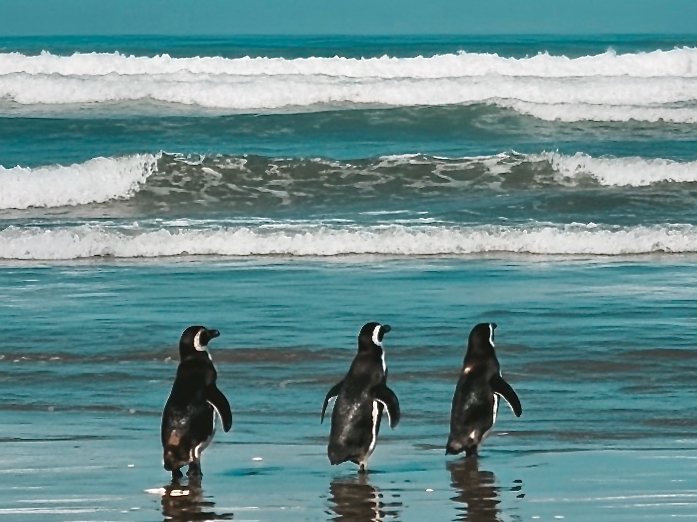
Since August, injured marine animals have been cared for at the rescue station for marine animals in Coquimbo. The station is jointly supported by the NGO Conservación Humboldt, the Universidad Católica del Norte-UCN (2), Sernapesca (3) and Sphenisco. At the end of November, the first "patients", three Magellanic penguins, were released into the wild. (see article "Penguins released into the wild from 21 November). The rescue station is scheduled to be officially opened on December 5, 2025.
+++Investigation of the migration of Humboldt penguins+++
From July to September, Antarctic Research Trust and Sphenisco investigated the migration of Humboldt penguins after the breeding season for the first time. In July, researchers Thomas Mattern (New Zealand) (4), Paulina Arce and Maximilian Daigre (both from Chile) equipped five breeding Humboldt penguins on the island of Cachagua with satellite transmitters.
At the end of November, Thomas Mattern briefly informed about the results: "Surprisingly, the penguins did not undertake any major migrations outside of breeding, but remained mainly in the area of the coasts around Valparaíso and Viña del Mar. In these regions, there is heavy shipping traffic, but only little activity by small-scale fishers. This suggests that Humboldt penguins avoid areas with intense fishing transpire, even if other human influences are present there."
+++Second Literary Competition+++
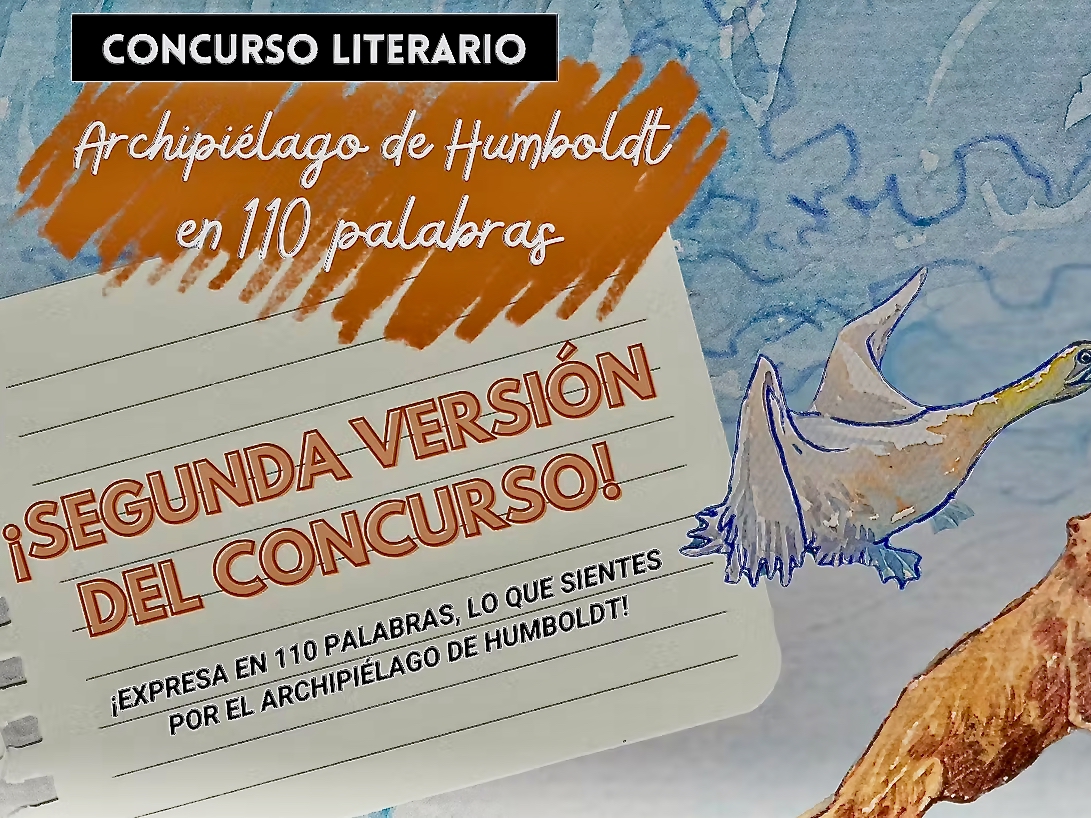
After the great success of the literary competition "The Humboldt Archipelago with 110 Words", the Fundación Sphenisco Chile has once again launched the competition. This time, the deadline for submissions is December 28, 2025. The project is supported by the municipality of La Higuera, international organizations such as Sphenisco e.V., the sponsors Zoo Rostock and Ouwehand Zoo Foundation, as well as national and local organizations (see article "Second Literary Competition ..." from 9 November).
+++Sharp decline in population+++
The population of Humboldt penguins has been greatly reduced in recent years. The article "Are we to blame for the extinction of the Humboldt penguins" on this website provides information about reactions of state institutions and the symposium organized by Fundación Sphenisco Chile, "The Humboldt penguin is threatened with extinction: challenges for its rescue". The meeting brought together renowned researchers, experts and organizations to reflect on and discuss scientific findings, management strategies, environmental education and legal foundations.
+++New study of foraging+++
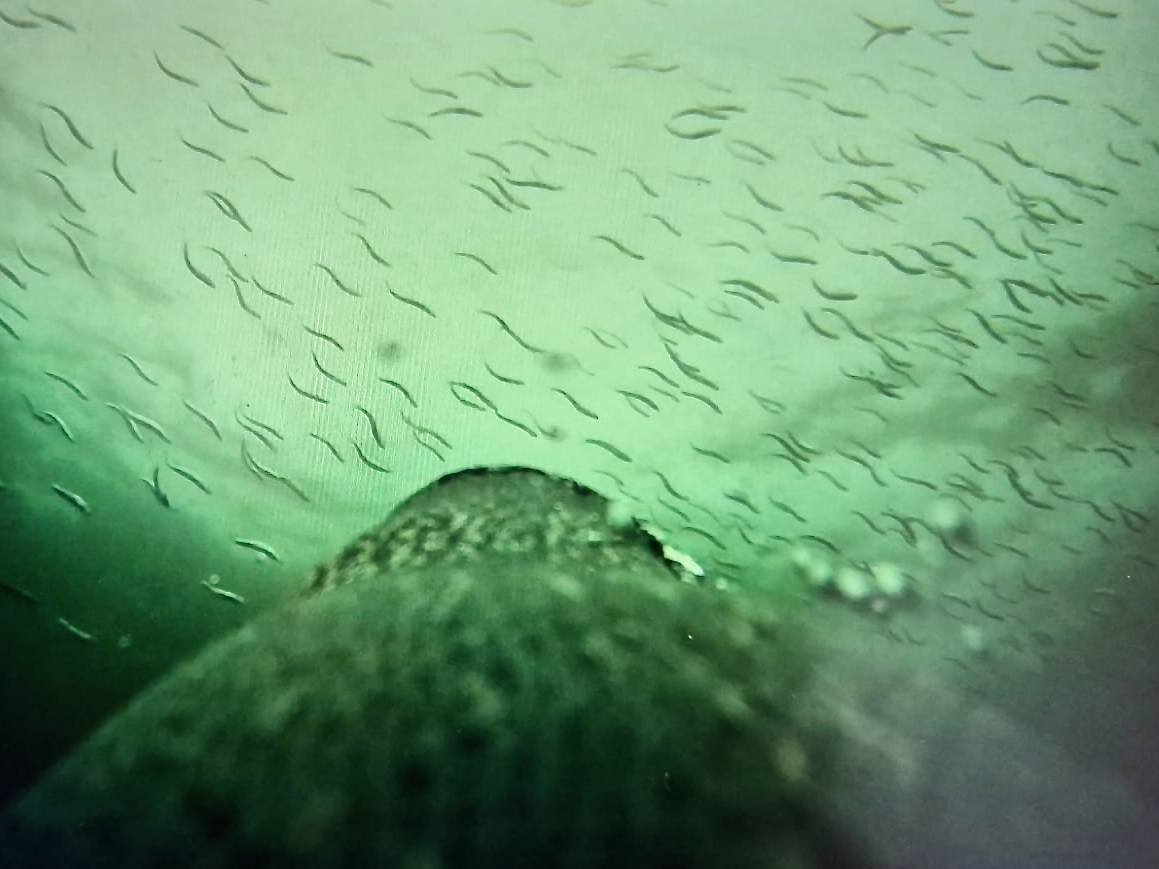
In November, Ursula Ellenberg (4), Paulia Acre and Maximilian Daigre again researched foraging. The survey on the island of Cachagua was very successful. 10 GPS loggers could be installed and recovered with good data. A small camera could also be used again and recordings of the search for food could be taken.
P E R U
+++Care for injured penguins+++
In response an inquiry from Sphenisco, Acorema says the following about the care of injured penguins in Peru: "There are ... in Peru, two state institutions responsible for the protection of the Humboldt penguin: SERNANP (5) and SERFOR (6). Depending on where the injured animal is found, another institution is responsible. The SERNANP is responsible if the injured animal is found within a nature reserve, while the SERFOR takes over this task if the animal is found outside a protected area.
There are deficits at SERNANP because there are not enough specialist staff for the initial care of the animals. That is why aid is coordinated by SERFOR. SERFOR has veterinarians who help stabilize the penguins and, depending on the bird's condition, decide whether it needs further care or can be released.
Currently, there are no rescue stations for marine animals in Peru. If the care of one or more Humboldt penguins is required, they are taken to zoos that can accommodate injured animals, depending on the region (Lima or province). In the Ica region, penguins are usually taken to the municipal zoo. If more intensive care is required, the penguin can be brought to Lima, as the largest zoos in the country are located there."
+++Moult counts Peru+++
It is planned to publish the results of the regular moult census in Peru in a scientific journal. Currently "... , the research team is working on a publication that summarizes the results of all counts (for 25 years). Therefore, the completion of the publication will take some time."
+++Research on foraging+++
Ursula Ellenberg, New Zealand, plans to study the foraging of Humboldt penguins in Peru in 2026, together with Acorema. After consultation with the island’s guardians, the investigation is to be carried out on the island of Asia near Lima. Acorema is currently coordinating the logistics with the responsible body and applying for the necessary permits.
E U R O P E
+++"A "wacky idea" becomes reality"+++
For almost 50 years, the district of Südliche Weinstraße has been publishing a homeland yearbook. The 2026 yearbook was published in mid-November and was dedicated to the topic of "Stage and Screen in the Southern Palatinate". Gabriele and Werner Knauf have produced a series of films about Humboldt penguins and the history of the region for the "screens" of the Palatinate. Werner Knauf was therefore asked to report on their joint cinematic commitment. This is how the article "A ‘wacky idea’ becomes reality” came about. The article tells the story of Sphenisco and recalls films about Humboldt penguins and species conservation that accompanied the development of the association. The "wacky idea" can now also be read on Sphenisco's website under the menu item "About us - club history".
+++Penguin Day at Mikado+++
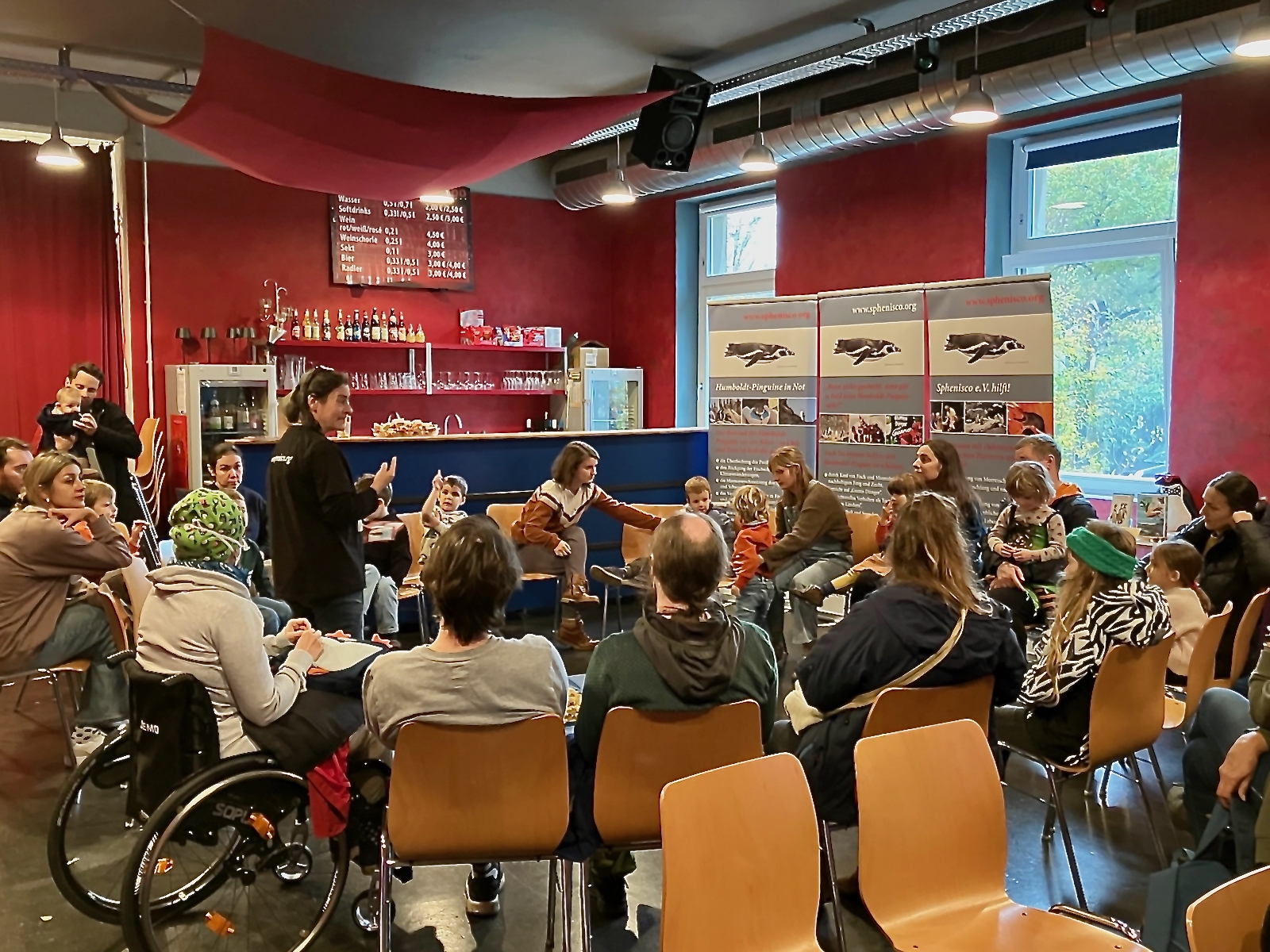
On the initiative of German Contreras, Sphenisco organized a "Penguin Day" at the Karlsruhe Kulturhaus Mikado on November 9, 2025. Children in particular were invited to penguin films, face painting, handicrafts and information. The Sphenisco team - in addition to the Contreras, Katja Resch, Jeannine Schützendübe and Werner Knauf - took the young and old visitors on a trip to the Humboldt penguins. The first stop was the video about food-seeking penguins by Thomas Mattern. The great underwater shots were so fascinating that the video had to be played again. The next stop was the breeding island of Pan de Azucar in northern Chile. From there, vulture Gonzales reported in the film "Penguin Pepe in Need" about the life of his friend Pepe and the dangers he is exposed to. Jeannine Schützendübe divided the film into three sections, which she then discussed with the children. Afterwards, the little ones went to an adjacent room to make penguins. The adults used the time for intensive discussions. At the end, "Penguin Pepe in Need" was shown again for additional visitors.
+++International Penguin Conference IPC12+++
The 12th International Penguin Conference (IPC12) will take place from August 31 to September 5, 2026 at Phillip Island, Australia. Thomas Mattern (6) has been invited as a keynote speaker. He is expected to present a summary of his ten years of penguin research including his investigations of Humboldt penguins. Ursula Ellenberg (6) and Alejandro Simeone are also planning contributions; Ursula Ellenberg on foraging and Alejandro Simeone on the development of the population of Humboldt penguins in Chile. Nancy Duman from Fundación Sphenisco Chile and our members Isa Karbstein and Volker Eggert are preparing two poster presentations, with the working title "The Endless Struggle for the Humboldt Archipelago" and "Research, Environmental Education, Public Relations for the Conservation of the Humboldt Penguins".
+++WimmerX of the month+++
The cabaret poetic singer-songwriter and author Rainer Markus Wimmer from Karlsruhe, Germany (www.wimmerx.de www.facebook.com/wimmerx/) published a "Wimmerick" in November and allowed Sphenisco to post it.
"Growth and innovationThe earth's problems are widely known:
Too much of everything in the sea, air and land. Only one thing is decreasing, the diversity of species. Growth and greed have better cards. The solution is supposed to be what you've already heard: "We need growth and innovation." But if my memory doesn't escape me, then we had both globally in the world to an extent never seen before. As an example, the Chinese. So one asks the question, quite uncomfortably: Why does the problem exist at all?"
+++Donations, Donations, Donations+++
In October and November 2025, the following people and institutions donated to Sphenisco's species conservation projects: Kathrin Ballenthin, Rostock Zoo, Ouwehand Zoo Rhenen Foundation, Ulrich Treutlein, Mikado Karlsruhe Species Conservation Day, Dresden Zoo, Paultons Park, Four Wings Foundation Weltvogelpark Walsrode and Jan Schöne.
W.K.
Notes
For better readability, the generic masculine is used in this article. The personal names used in the article refer to all genders – unless otherwise indicated.
(1) Pacto No a Dominga. The "No to Dominga Pact" brings together environmental and social groups in the Coquimbo region. They criticize a lack of planning and impairments of health, transport and services due to possible population growth.
(2) Universidad Católica del Norte-UCN - Catholic University of the North in Coquimbo, Northern Chile.
(3) Sernapesca. Servicio Nacional de Pesca y Acuicultura - National Service of Fisheries and Aquaculture.
(4) Thomas Mattern and Ursula Ellenberg work at the University of Otago, New Zealand and are part of the research group led by Dr. Alejandro Simeone (Andrés Bello University, Santiago), who have been conducting studies on the population, breeding success and foraging of the Humboldt penguin in Chile on behalf of Sphenisco since 2021. The research is funded by the Karlsruhe Zoo Species Conservation Foundation, Dresden Zoo and the Hagenbeck Zoo Association.
(5) Servicio Nacional de Áreas Naturales Protegidas – SERNANP – National Service for Nature Reserves.
(6) Servicio Nacional Forestal y de Fauna Silvestre – SERFOR) - National Service for Forestry and Wildlife.
translated by Erich Greiner