



Landau 11. September 2026.
In the southern spring of 2025, researchers Dr. Ursula Ellenberg (1) and Maximiliano Daigre Valdés (2) once again investigated the foraging of Humboldt penguins from the islands of Cachagua and Choros in northern Chile. The research is part of the studies on population, breeding success and foraging that have been carried out since 2021 under the direction of Dr. Alejandro Simeone (3). The multi-year research project was commissioned by Sphenisco and is funded by the Karlsruhe Zoo Conservation Foundation, Dresden Zoo and the Hagenbeck Zoo Association.
Projects in Chile

Landau, September 7, 2026.
On the initiative of the NGO Oikonos, the Universidad Científica del Sur (Dr. Carlos Zavalaga, Peru), and Sphenisco, scientists, NGOs, and policymakers established a binational working group on August 24, 2026, dedicated to the conservation of Humboldt penguins.
The reason for this is the alarming decline in the population in Chile and Peru. The goal of the initiative is to analyze the current situation of the Humboldt penguin in both countries, identify conservation priorities, improve coordination and cooperation, and promote scientifically sound measures.
Landau, August 10, 2026.
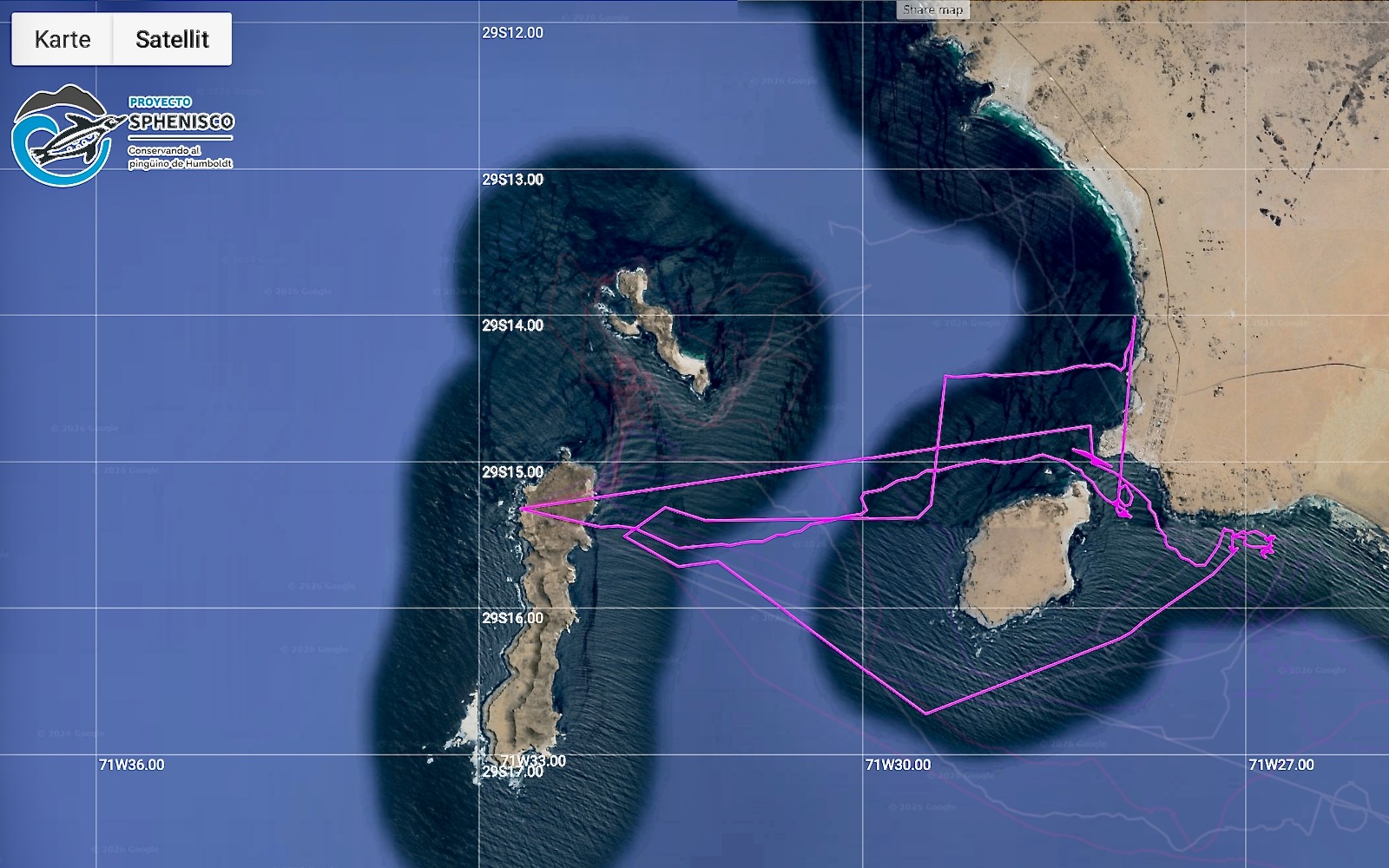
From July through September 2025, M. Daigre (1), P. Arce (1), and A. Simeone (1,2) studied the migration of Humboldt penguins on behalf of the Antarctic Research Trust (ART) (3). Toward the end of the breeding season, the researchers fitted five penguins from the breeding island of Cachagua with satellite transmitters. Alejandro Simeone describes the monitoring as follows:

Coquimbo, Landau, 12 August 2026.
Since 2021, a research group led by Dr. Alejandro Simeone (1) has been conducting research on the population, breeding success and foraging of the Humboldt penguin in Chile on behalf of Sphenisco. The project is funded by the Karlsruhe Zoo Conservation Foundation, Dresden Zoo and the Hagenbeck Zoo Association. Guillermo Luna-Jorquera (2), Nicolás Luna (2) (3), Karen Lau (2), Mylene Seguel (2) (4) submitted a final report in August 2026 regarding the breeding success in the period 2021 to 2025. The report is entitled "Reproductive behaviour of the Humboldt penguin (Spheniscus humboldti) on the islands of Chañaral and Choros in the "Pingüino de Humboldt" National Reserve, period 2021–2025" (see PDF file). The researchers plan to publish the report in a journal. Excerpts and short chapters are reproduced below:

La Serena, Landau, 29 July 2026. These were the worst storms in the regions of Coquimbo and Atacama in decades. At least ten people were killed, many were injured. Due to impassable roads and power outages, around 100,000 people were cut off from the outside world for days and in some cases without drinking water for longer. More than a thousand people had to be accommodated in emergency shelters. The damage to houses, roads and port facilities is enormous, the full extent cannot yet be estimated.

La Serena, July 14, 2026.
The “Literary Contest” initiative collected submissions from the provinces of Elqui, Limarí, and Choapa, thereby using literature to help promote appreciation for and protection of one of the most important marine ecosystems in Chile and the world.
At a press conference on Monday, July 13, the jury of the second “Humboldt Archipelago in 110 Words” literary contest announced the names of the winners in the children’s, youth, and adult categories.

Landau, May 25
The NGO Acorema (Peru) and the Fundación Sphenisco Chile launched the campaign “¡Salvemos juntos al pingüino de Humboldt!” (1) to mark World Penguin Day 2026. The survival of Humboldt penguins is threatened by highly pathogenic avian influenza (H5N1), El Niño, overfishing, bycatch, and disturbances or destruction of breeding sites. As of the end of 2025, the Chilean population had declined by 63% compared to 2021/22. Currently, there are only 1,001 breeding pairs remaining (2). This sharp decline prompted Chilean authorities to upgrade the species’ conservation status from “vulnerable” to “endangered.” In Peru, the population declined by 70% in 2024 compared to 2023. At the beginning of 2024, only 5,035 molting penguins were counted (3). The sharp decline in the population could be dramatically exacerbated by a new outbreak of avian influenza—detected in Chile in March 2026—and an El Niño phenomenon forecast for late 2026.

Landau, April 21, 2026. Since August last year, the marine rescue center in Coquimbo, northern Chile, has been caring for injured and sick marine animals. Sphenisco has repeatedly reported on the project’s progress, most recently on December 6, 2025, and January 25, respectively January 2026. The center is jointly operated by the Universidad Católica del Norte (UCN) (1), Sernapesca (2), the NGO Conservación Humboldt (3), and Sphenisco. The sick marine animals are cared for by veterinarians and animal caretakers of the NGO Conservación Humboldt. With support from the zoos in Dresden, Frankfurt, and Halle, Sphenisco financed the renovation of the station and covered the operating costs for one year. In early April 2026, Conservación Humboldt submitted, as planned, the second report—covering the period from December 2025 to March 2026—on the progress of the project (4):

Landau 25 March 2026. Dr. Alejandro Simeone has presented new figures on the population of Humboldt penguins (1) and confirmed the sharp reduction in the population - by 63% compared to 2021/22 - also for Chile. The current surveys are part of a 6-year research project commissioned by Sphenisco and are funded by the Karlsruhe Zoo Species Conservation Foundation, the Friends of Hagenbeck Zoo and the Dresden Zoo. The following text presents the most important result and the discussion of the results. Summaries, introduction, material and methods, further results, full discussion, acknowledgements and literature can be found in the full report (1) (2) (to be submitted later).
Subcategories
Sphenisco e.V.
Note
All images are the property of Sphenisco e.V. or the photographers named.
Use is only permitted after consultation and approval.
