Landau, April 2, 2026
C H I L E
+++Wetlands Festival+++
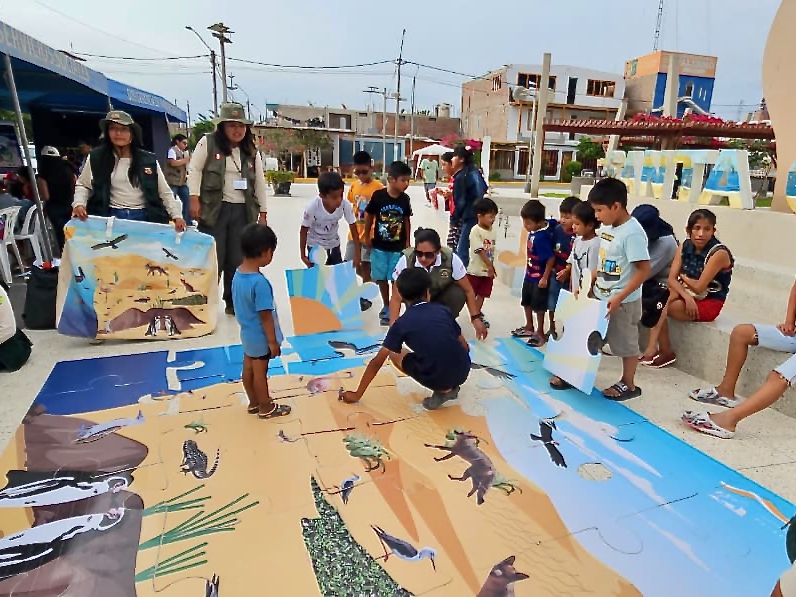
In early February 2026, the City of Coquimbo and the NGO Oikonos hosted the first “Raíces del Humedal” festival in O’Higgins Park (1). To mark World Wetlands Day (February 2), they invited numerous organizations—including Fundación Sphenisco Chile—to organize a day dedicated to education, knowledge, learning, and the protection of the Peñuelas area. The aim was to raise awareness of the importance of “wetlands” and to highlight the value of these ecosystems. In addition, the campaign sought to bring public attention to individuals and organizations that are committed to protecting wetlands. Fundación Sphenisco Chile focused its efforts on the Humboldt penguin. Throughout the day, there were creative workshops, artistic performances, scientific activities, and community events for all age groups. https://www.youtube.com/watch?v=xc9u_lbkZxk
+++Photo Exhibition “Exploring the Archipelago”+++
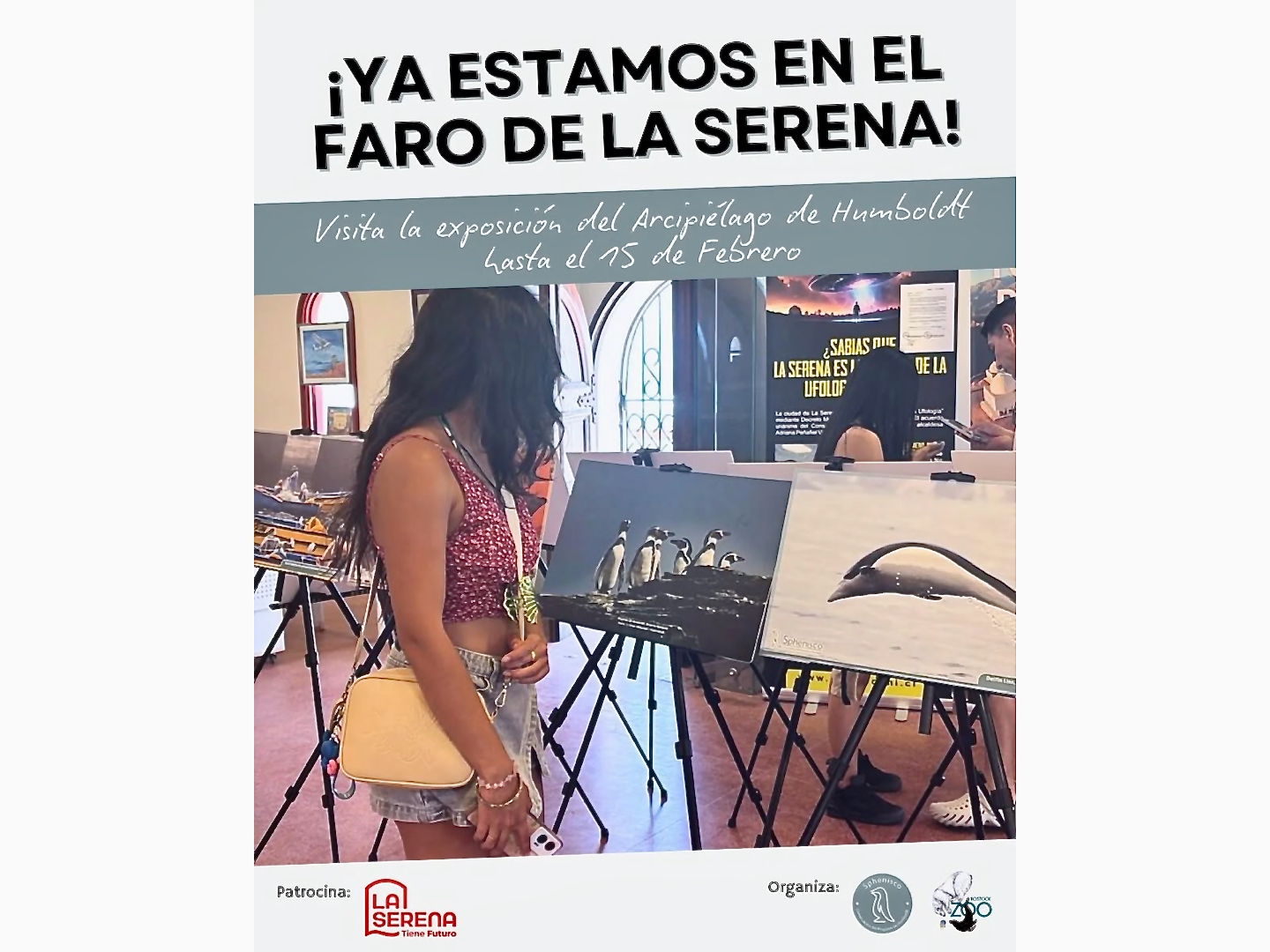
The photo exhibition “Explorando el Archipiélago” at El Faro in La Serena came to a close in mid-February. For four weeks, Fundación Sphenisco Chile presented the exhibition “Exploring the Humboldt Archipelago: Source of Life for Humanity” at the La Serena Tourist Center. The exhibition was visited by 50,000 to 60,000 people. (See the articles “Penguin Awareness Day” and “December/January Newsletter” 2025/26). The Foundation plans to showcase the successful exhibition at additional venues in the Coquimbo region in the coming weeks.
+++Research for Survival+++
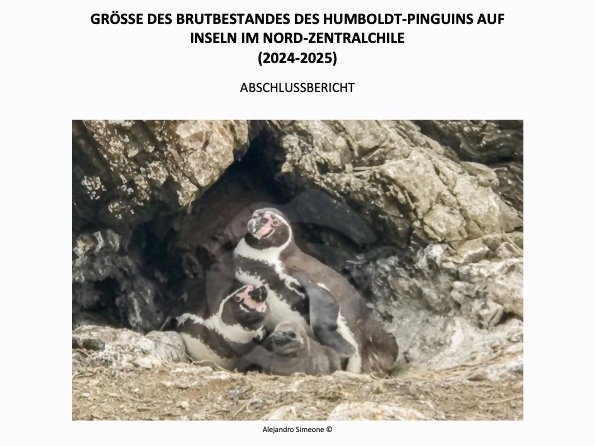
In March, Dr. Alejandro Simeone presented new figures on the Humboldt penguin population in Chile. The research report “Size of the Humboldt Penguin Breeding Population on Islands in North-Central Chile (2024/2025)” documents a sharp decline in the population of 63% compared to 2021/22 for Chile (see “Population (…) Reduced by Nearly Two-Thirds” from March 25, 2026).
+++Research findings on foraging published in a scientific journal+++
The master’s thesis “Spatio-temporal overlap between purse seine fishing and the foraging areas of Humboldt penguins in northern Chile” (2) by Isabel Bastías of Santiago has been published in the scientific journal PeerJ. https://peerj.com/articles/20714/
This study is part of a multi-year research project on population size, breeding success, and foraging behavior (3), funded by Sphenisco. The publication fees for PeerJ were covered by the Global Penguin Society.
+++ Conservation Project Halted+++
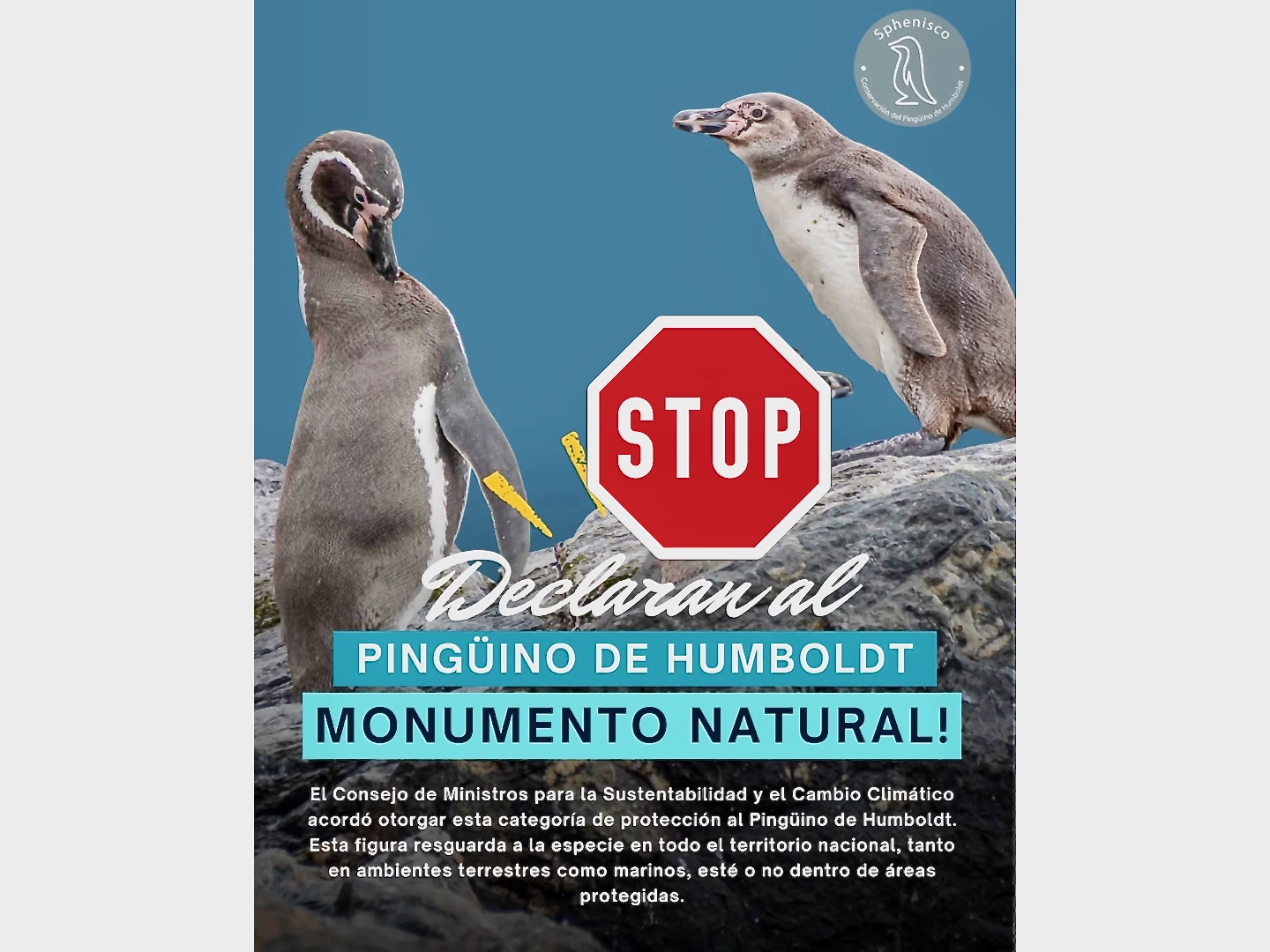
The designation of the Humboldt penguin as a natural monument marks a milestone in the conservation of biodiversity in Chile, particularly that of the Humboldt penguin. It was and remains a major success for civil society groups—including Fundación Sphenisco Chile—and scientists to have secured this designation (see article “Major Success (...)”, February 16, 2026).
The joy over this progress was short-lived. Just one week after taking office, the new Kast administration put the declaration on hold and announced that it would be subject to technical and legal review. In doing so, officials are denying potential protection to a severely endangered penguin species in an extreme emergency situation (see “Kast Administration Halts (...)” March 19, 2026).
+++Rejection of the “Dominga” Mining and Port Project Confirmed+++
Civil society groups in Chile and penguin lovers around the world celebrated another major victory for species conservation. On February 21, 2026, the Chilean judiciary announced that all decisions by the First Environmental Court of Antofagasta have been overturned and that the Chilean government’s rejection of the “Dominga” project remains in effect (see article “Major Victory for Species Conservation,” February 24, 2026).
As expected, Andes Iron responded to the heavy defeat by taking new legal action. The company filed an appeal with the First Environmental Court of Antofagasta against the government’s decision from January 2025 (!). Andes Iron also filed a complaint with the Supreme Court in Santiago against the appellate court’s ruling of February 21
Alianza Humboldt responded to this development with the podcast “Dominga Rejected!” (Alianza Humboldt Facebook page, February 26) and wrote: “The Humboldt Archipelago is once again at the center of the national debate.” In this special podcast, we analyze what the recent court ruling means and what lies ahead for the La Higuera region. (…) The Humboldt Archipelago is not just a project. It’s about biodiversity. It’s about community. It’s about the future.”
+++Literary Contest “The Humboldt Archipelago in 110 Words”+++
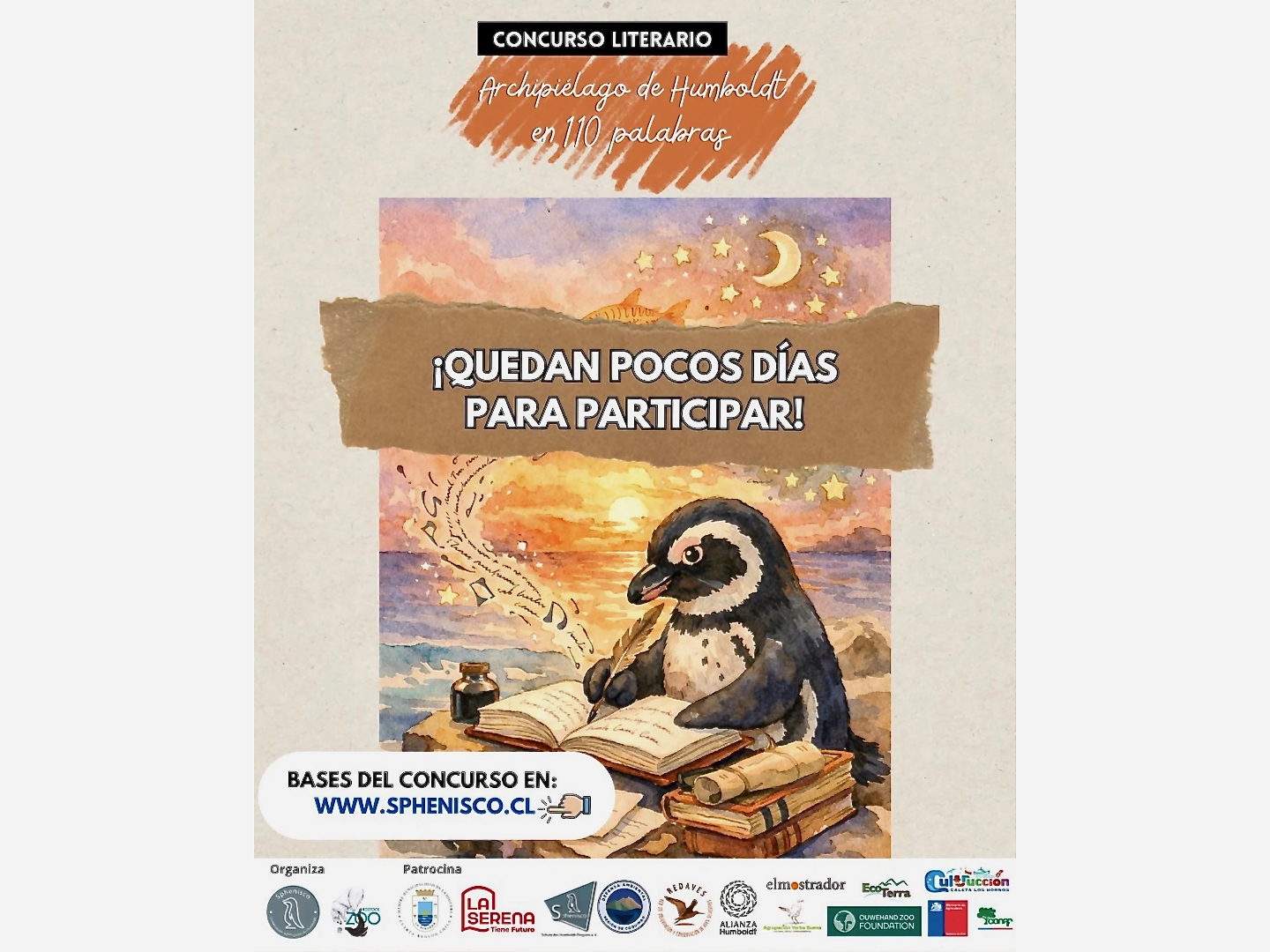
Following the great success of the literary contest in 2024, Fundación Sphenisco Chile announced the contest again at the end of 2025. Entries were accepted until March 31.
P E R U
+++World Wetlands Day+++
The NGO Acorema issued the following appeal on World Wetlands Day (February 2): “Today, many organizations will once again carry out cleanup campaigns, give presentations, post on social media, and sign pledges. After these activities, we are left with the feeling that not enough is being done, that we cannot wait until next year (…) Many wetlands are disappearing before we even get to know them.” “We are reclaiming some of them and trying to document and raise awareness of their biodiversity, (…) This is an important step toward conserving these areas. Let’s work with children and young people in schools so they can learn about these ecosystems and their value, and help us change adults’ attitudes. It is those attitudes that are currently causing the main problems in the wetlands. Let’s do our part!”
+++Workshop for Young Scientists+++
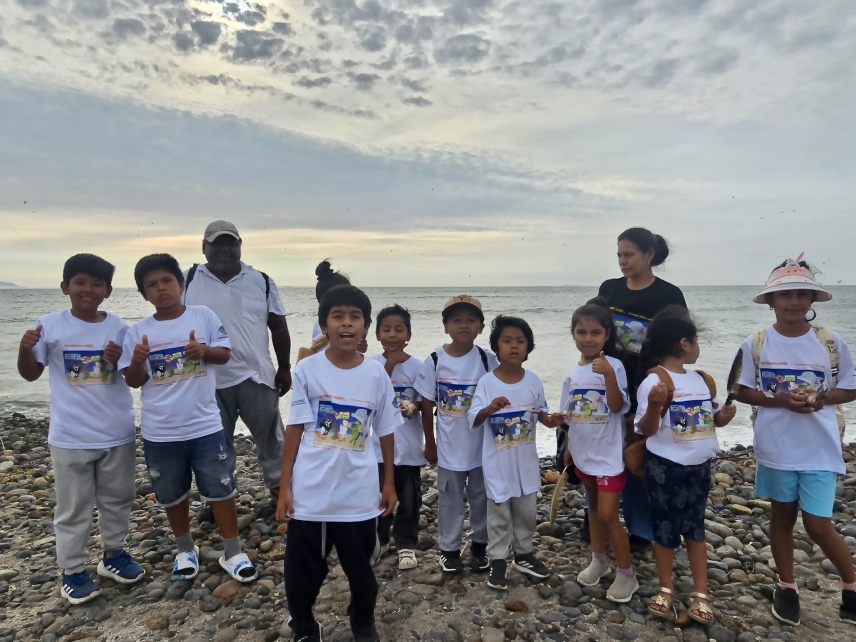
At the end of February, the NGO Acorema organized a workshop for “young scientists” and reported: “Children from the Paracas region visited the large ‘nature laboratory’ in their area. During a visit to the Paracas National Reserve, they learned more about the riches and great importance of their ocean.” The children visited the National Reserve’s information center. There, park rangers taught them about the reserve through activities such as a puppet show. They also had time to play and have fun on the beaches. It was a day filled with smiles, curiosity, and a love of nature.
E U R O P E
+++Sphenisco Flyer+++
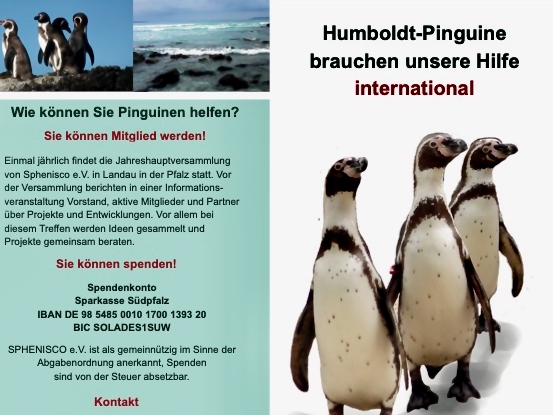
The flyer “Humboldt Penguins Need Help – Internationally” is still relevant even after ten years. However, details such as the association’s address and bank information were no longer correct. For this reason, the flyer was revised, and a new print template was designed by Juli Hornen, a long-time member of Sphenisco. The flyer is available at https://www.sphenisco.org/documents/Sphenisco_Flyer.pdf?v=2.
Flyers can also be ordered from “Sphenisco e.V. c/o Zoo Landau, Hindenburgstrasse 12, 76829 Landau.”
+++“Show Your Face!” Campaign+++
The risk of Humboldt penguins becoming extinct has increased significantly. Sphenisco is therefore asking penguin lovers, partners, and members to support the “Show Your Face!” campaign on World Penguin Day (April 25) or at another suitable time (see “Show Your Face!” campaign from March 27, 2026).
The NGO Acorema says of the campaign: “We will make sure to publish the campaign images. We have already planned activities with schools for Humboldt Penguin Day. The idea of reporting on these activities is excellent. It will be meaningful for the public to see how institutions in three different countries are joining forces to protect the Humboldt penguin and its habitat.”
+++Support for "Blair Drummond Safari Park"+++
The coordinator of Blair Drummond Safari Park in Scotland wrote: “We would be delighted (…) to raise funds through our ‘Connection to the Wild’ initiative and draw attention to the incredible work of your charity. Together with our animal care teams, we organize a monthly information booth from April through October to generate significant awareness and donations.” Donations are also accepted via donation boards in the park, following our daily animal talks and training demonstrations, through a coin-operated wishing well, and online via our website. At the end of the season, we distribute the funds to various charitable organizations.
Blair Drummond Safari Park has been regularly raising awareness about the threats facing the Humboldt penguin and its habitat since last year and has supported the work of Sphenisco.
+++Penguins in RTL’s “Life” Magazine+++
In late March, the weekly magazine “Life” reported on the threats facing penguins (4). The program focused on the rescue center in Coquimbo (5) and the results of Sphenisco’s six-year research project. Dr. A. Simeone presented new findings on population size and foraging behavior (3), particularly the fascinating underwater footage, and highlighted the threats posed by fishing. Viewers learned from Werner Knauf, chairman of Sphenisco (RTL Media Library, “Life,” broadcast on March 28, 2026), why Humboldt penguins are receiving help even from faraway Europe and how this assistance came about. Four viewers made spontaneous donations after the broadcast. Thank you very much! Sphenisco looks forward to further responses.
+++Donations, Donations, Donations+++
In February and March 2026, the following individuals and organizations donated to Sphenisco’s species conservation projects: Olaf Goldbecker, Kathrin Ballenthin, Folly Farm Leisure Limited, Dublin Zoo, Saarbrücken Zoo, Ulf and Susanne Janz, Anja and Reinhold Knauber, Dr. Ingrid Schönleber, Hans-Jürgen Klute and Marita Kaiser-Klute, Klaus and Michele Lenz, Dr. Kerris Isolde Klug, Dr. Michael Brünger, and Karin Flurer-Brünger, Blair Drummond Safari Park, Paultons Park, Julian Meier, Steffen Schermeyer, Michael Herzog, Martin Kaiser, Camila Herrera Lara, Rj Szremski, Dominik Reinhard, Fabiola Brenner, Christine Stiem-Rach, Kai Graebner, Barbara Tomann.
W. K.
notes
For the sake of readability, the generic masculine form is used in this article. Unless otherwise indicated, the terms used to refer to people in this article apply to all genders.
(1) Raíces del Humedal. English: Roots of the Wetlands.
(2) Original title: Spatio-temporal overlap between purse seine fisheries and Humboldt penguin feeding areas in northern Chile“.
(3) The research findings are part of a six-year research project on population size, breeding success, and foraging behavior, which is being conducted by researchers A. Simeone, P. Arce, M. Daigre, G. Luna-Jorquera, U. Ellenberg, and T. Mattern on behalf of Sphenisco. The research is funded by the Species Conservation Foundation of the Karlsruhe Zoo, the Friends of Hagenbeck Zoo, and the Friends of Dresden Zoo.
(4) The documentary was produced by Regina Niedenzu and Dirk Rensmann in 2025/26.
(5) The marine animal rescue center in Coquimbo, northern Chile, is jointly operated and managed by the Universidad Católica del Norte (UCN), Sernapesca, Sphenisco, and the NGO Conservación Humboldt. The renovation and current operation of the station are funded by the zoos in Dresden, Frankfurt, and Halle.
translated by Claudia Fawer