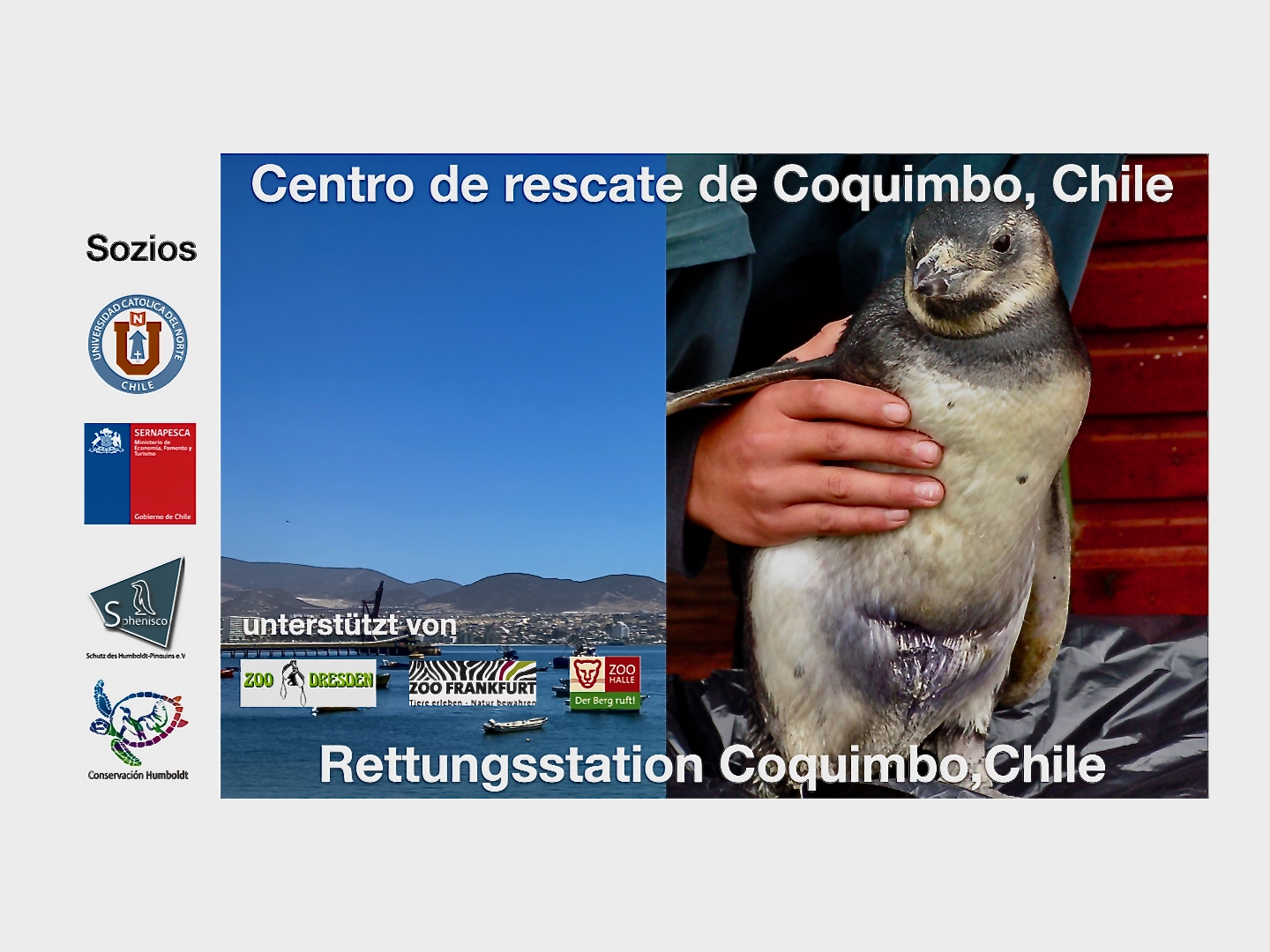
Landau, January 25, 2026. The marine animal rescue station in Coquimbo, northern Chile, is jointly supported and managed by the Universidad Católica del Norte (UCN) (1), Sernapesca (2), Sphenisco, and the NGO Conservación Humboldt (3). It is funded by the zoos in Dresden, Frankfurt, and Halle. At the beginning of January, Conservación Humboldt reported in detail on the development of the rescue station in accordance with the contract:
Progress Report Conservación Humboldt
After the handover by the construction company on August 1, 2025, a veterinarian and specialist staff were hired, consumables and medications were procured, and equipment such as a stainless steel table, a foldable basin, feeding tubes, ventilators, and digital scales were gradually acquired, thus creating the minimum requirements for operations. To date, 14 wild animals – often in very critical condition – have been admitted, including Magellanic penguins, Humboldt penguins, olive ridley sea turtles, and a sea lion. In November 2025, three Magellanic penguins were released back into the wild. The official opening on December 5 was met with great enthusiasm. Numerous municipal, academic, and government institutions and many media outlets took part. The project became known to the public through reports in national and international media, including Televisión Nacional de Chile (TVN), the Mega television station, Deutsche Welle, German documentary filmmakers Regina Niedenzu and Dirk Rensmann, and the daily newspaper Diario El Día. In the first few months, the NGO Conservación Humboldt has developed a number of partnerships: with Orizon fisheries to ensure food supplies, with the Universidad del Alba for academic cooperation, and with the Biocellvet laboratory and veterinary clinics for access to specialized diagnostics.
In “Life” on RTL
Documentary filmmakers Regina Niedenzu and Dirk Rensmann have produced a feature on Chile's Atacama Region for “Life – Menschen, Momente, Geschichten” (RTL). The magazine program “Life” reaches an average of 1-1.5 million viewers and is broadcast on Saturdays at 7:05 p.m. “Life” aims to showcase extraordinary people who have achieved outstanding things and report on moments that move and inspire. The feature on the Atacama region reports on Sphenisco's projects with a focus on the rescue station in Coquimbo. The documentary filmmakers shot the film at the station in December 2025 and, as mentioned, were also able to attend the official opening. They also interviewed researcher Dr. Alejandro Simeone and Nancy Duman, president of Fundación Sphenisco Chile. In January 2026, the filmmakers met Werner Knauf, chairman of Sphenisco, at the penguin enclosure at Landau Zoo and asked him for a few short statements. The feature is already complete. It is not yet known when it will be broadcast. Sphenisco is eager to see how the magazine “Life” will report on and classify the projects. The association will try to announce the broadcast date in good time.
W.K.
Notes
For better readability, the generic masculine form is used in this article. Unless otherwise indicated, the terms used in this article refer to all genders.
(1) Universidad Católica del Norte-UCN. English: Catholic University of the North in Coquimbo, northern Chile.
(2) Sernapesca. Servicio Nacional de Pesca y Acuicultura. English: National Service for Fisheries and Aquaculture.
(3) The NGO Conservación Humboldt is dedicated to the conservation of marine animals and operates the rescue station on the grounds of the Catholic University of the North in Coquimbo.
Translated with DeepL.com and checked by Angelika Veelken